
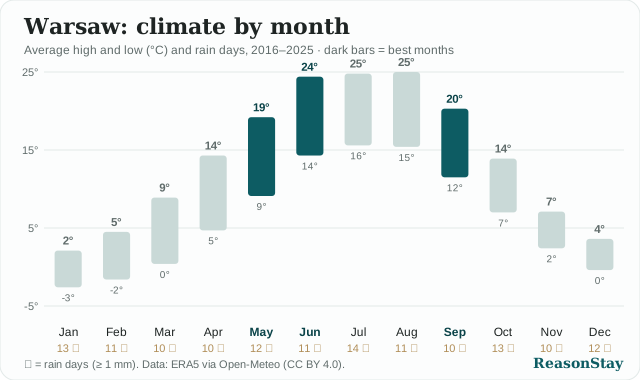
The best months to visit Warsaw are May, June and September. June brings an average high of 24.4 °C with 11 rain days and ranks as the city's sunniest month, while September eases back to 20.3 °C with just 10 rain days — comfortable warmth without the midsummer intensity, and May sits pleasantly between at 19.2 °C. July and August are peak season, when school holidays fill the Old Town and prices climb. Winter is the quiet low season: short, dull days with highs near 2.1 °C in January, best for those who want Warsaw without the queues.
Best months MayJuneSeptember
Warsaw month by month
Average highs and lows (°C), 2016–2025. Highlighted bars are the best months.
| Month | High | Low | Rain days | Sunshine | Days ≥30 °C | Crowds |
|---|---|---|---|---|---|---|
| January | 2.1 °C | -2.6 °C | 13 | ●●●●● | – | ●●●●● |
| February | 4.5 °C | -1.6 °C | 11 | ●●●●● | – | ●●●●● |
| March | 8.9 °C | 0.4 °C | 10 | ●●●●● | – | ●●●●● |
| April | 14.3 °C | 4.7 °C | 10 | ●●●●● | – | ●●●●● |
| May | 19.2 °C | 9.1 °C | 12 | ●●●●● | – | ●●●●● |
| June | 24.4 °C | 14.3 °C | 11 | ●●●●● | 3 | ●●●●● |
| July | 24.8 °C | 15.6 °C | 14 | ●●●●● | 3 | ●●●●● |
| August | 25 °C | 15.4 °C | 11 | ●●●●● | 4 | ●●●●● |
| September | 20.3 °C | 11.5 °C | 10 | ●●●●● | – | ●●●●● |
| October | 13.9 °C | 7 °C | 13 | ●●●●● | – | ●●●●● |
| November | 7.1 °C | 2.4 °C | 10 | ●●●●● | – | ●●●●● |
| December | 3.6 °C | -0.4 °C | 12 | ●●●●● | – | ●●●●● |
How the months are picked.A month qualifies when its average high sits in the comfortable 20–28 °C band (scored down towards 9 °C and 37 °C), rain days are few and sunshine hours are high — at least 78 % of the city's best-scoring month. July and August are then set aside as peak season (school-holiday crowds and prices) whenever at least three other months qualify; where summer is the only comfortable window they stay. Figures are ten-year averages (2016-01-01 to 2025-12-31) from ERA5 reanalysis data via Open-Meteo (CC BY 4.0) for the city centre coordinates. Sunshine is shown relative to the city's own year (modelled data overstates absolute hours).Heat and sea: days with a high of 30 °C or more are averaged over 2016–2025 (ERA5).Crowds:Relative to an average month in the same region (Eurostat nights spent at tourist accommodation, by NUTS 2 region and month) — a measure of season, not of how crowded one city is compared with another. Busiest month August, quietest January; NUTS 2 region PL91, 2022–2025, Eurostat.
Use this chart on your site
Writing about Warsaw? Add this climate chart to your article or blog for free. Keep the credit line (CC BY 4.0).
Charts for other cities: all free climate charts.

When to go, and what to expect
Spring (Mar–May)
Ideal for mild sightseeing and blooming parks — May is a standout.
Summer (Jun–Aug)
June is the sweet spot; July and August suit those who don't mind crowds.
Autumn (Sep–Nov)
September is one of the year's best months — warm, sunny and calmer.
Winter (Dec–Feb)
Worth it for markets and lights, if you can handle the chill.
Notable events
- Sundays, May to September
- Chopin Concerts in Łazienki Park
- December
- Warsaw Christmas Market in the Old Town
- Summer
- Orange Warsaw Festival
- June
- Wianki (Midsummer celebrations by the Vistula)

Frequently asked
Is Warsaw too hot in August?
No. August highs average 25 °C — warm but comfortable — with 11 rain days. The bigger issue is crowds, since August is peak school-holiday season.
What is the rainiest month in Warsaw?
July, with 14 rain days, is the wettest. January follows with 13 rain days. The best months are drier: September has just 10 rain days.
Is winter worth visiting Warsaw?
It's cold and dull — January highs reach only 2.1 °C and December is the least sunny month. But the Old Town Christmas market makes December atmospheric if you dress warmly.
Know when to go? Now decide where to stay — our Warsaw area guide →
Areas of Warsaw
Best time to visit near here
Sources
- Open-Meteo historical weather API — monthly climate normals, 2016–2025 (CC BY 4.0)
- ERA5 reanalysis (ECMWF / Copernicus) — the underlying temperature, precipitation and sunshine data
- ReasonStay methodology — how the best months are computed and checked
An independent guide to Warsaw — honest, verified, no invented data. Climate figures: ERA5 via Open-Meteo, 2016–2025 averages; the best months are computed from them, not opinion.