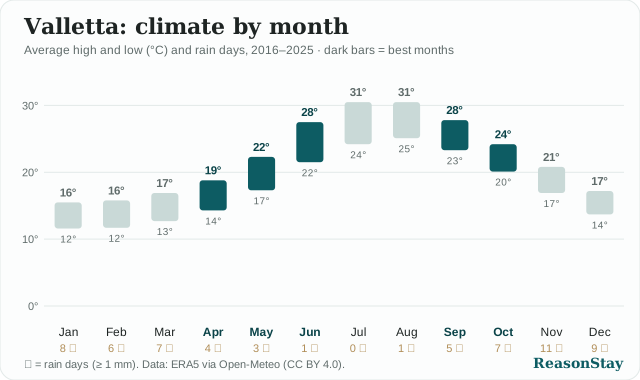
The best months to visit Valletta are April, May, June, September and October, when average highs sit comfortably in the 20s and rain is scarce — May averages a high of 22.3 °C with just 3 rain days, while June climbs to 27.5 °C with only 1 rain day. July and August are peak season, with average highs of 30.5 °C drawing school-holiday crowds and the year's busiest weeks. Winter is the quiet low season, cooler at around 15.5 °C in January and the dampest stretch, with November seeing 11 rain days.
Best months AprilMayJuneSeptemberOctober
Valletta month by month
Average highs and lows (°C), 2016–2025. Highlighted bars are the best months.
| Month | High | Low | Rain days | Sunshine | Days ≥30 °C | Sea | Crowds |
|---|---|---|---|---|---|---|---|
| January | 15.5 °C | 11.6 °C | 8 | ●●●●● | – | 17 °C | ●●●●● |
| February | 15.8 °C | 11.7 °C | 6 | ●●●●● | – | 16 °C | ●●●●● |
| March | 16.9 °C | 12.7 °C | 7 | ●●●●● | – | 16 °C | ●●●●● |
| April | 18.8 °C | 14.3 °C | 4 | ●●●●● | – | 17 °C | ●●●●● |
| May | 22.3 °C | 17.3 °C | 3 | ●●●●● | – | 19 °C | ●●●●● |
| June | 27.5 °C | 21.5 °C | 1 | ●●●●● | 8 | 24 °C | ●●●●● |
| July | 30.5 °C | 24.2 °C | 0 | ●●●●● | 16 | 27 °C | ●●●●● |
| August | 30.5 °C | 25.1 °C | 1 | ●●●●● | 18 | 27 °C | ●●●●● |
| September | 27.8 °C | 23.3 °C | 5 | ●●●●● | 5 | 27 °C | ●●●●● |
| October | 24.2 °C | 20.1 °C | 7 | ●●●●● | 1 | 24 °C | ●●●●● |
| November | 20.8 °C | 16.9 °C | 11 | ●●●●● | – | 22 °C | ●●●●● |
| December | 17.2 °C | 13.7 °C | 9 | ●●●●● | – | 19 °C | ●●●●● |
How the months are picked.A month qualifies when its average high sits in the comfortable 20–28 °C band (scored down towards 9 °C and 37 °C), rain days are few and sunshine hours are high — at least 78 % of the city's best-scoring month. July and August are then set aside as peak season (school-holiday crowds and prices) whenever at least three other months qualify; where summer is the only comfortable window they stay. Figures are ten-year averages (2016-01-01 to 2025-12-31) from ERA5 reanalysis data via Open-Meteo (CC BY 4.0) for the city centre coordinates. Sunshine is shown relative to the city's own year (modelled data overstates absolute hours).Heat and sea: days with a high of 30 °C or more are averaged over 2016–2025 (ERA5); sea-surface temperature is the monthly mean 2022–2025 at the nearest open-sea grid point within about 20 km (Open-Meteo Marine).Crowds:Relative to an average month in the same region (Eurostat nights spent at tourist accommodation, by NUTS 2 region and month) — a measure of season, not of how crowded one city is compared with another. Busiest month August, quietest January; NUTS 2 region MT00, 2022–2025, Eurostat.
Use this chart on your site
Writing about Valletta? Add this climate chart to your article or blog for free. Keep the credit line (CC BY 4.0).
Charts for other cities: all free climate charts.
When to go, and what to expect
Spring (Mar–May)
Ideal for sightseeing and walking the bastions — one of the best windows of the year.
Summer (Jun–Aug)
June still works well; midsummer suits sun-seekers who don't mind heat and crowds.
Autumn (Sep–Nov)
September and October are superb; the sea stays warm and the city breathes again.
Winter (Dec–Feb)
Good for culture and bargain-minded travellers happy to trade beach days for calm streets.
Notable events
- February
- Carnival
- March or April
- Holy Week and Easter processions
- Summer (June–July)
- Malta International Arts Festival
- October
- Notte Bianca, Valletta's all-night culture festival
Frequently asked
Is Valletta too hot in August?
August is hot, with an average high of 30.5 °C and only 1 rain day. It's manageable near the sea but intense midday, and it coincides with peak crowds — June or September offer similar warmth with more comfort.
What is the rainiest month in Valletta?
November is the wettest, with 11 rain days, followed by December with 9. The driest stretch is midsummer, with July seeing 0 rain days and June and August just 1.
Is winter worth visiting Valletta?
Yes, if you want quiet. Winter stays mild, with January highs around 15.5 °C and lows near 11.6 °C, though it's the dampest and least sunny season. It's great for cathedrals, museums and calm streets rather than beach days.
Know when to go? Now decide where to stay — our Valletta area guide →
Areas of Valletta
Best time to visit near here
Sources
- Open-Meteo historical weather API — monthly climate normals, 2016–2025 (CC BY 4.0)
- ERA5 reanalysis (ECMWF / Copernicus) — the underlying temperature, precipitation and sunshine data
- ReasonStay methodology — how the best months are computed and checked
An independent guide to Valletta — honest, verified, no invented data. Climate figures: ERA5 via Open-Meteo, 2016–2025 averages; the best months are computed from them, not opinion.